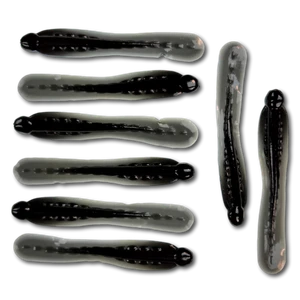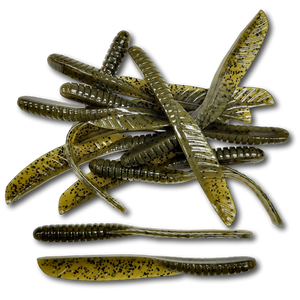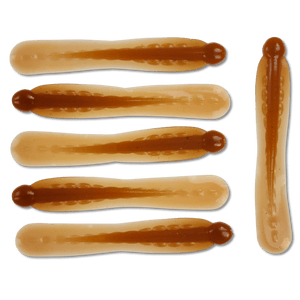

Soft Plastic Leeches
Soft plastic leeches are one of the cleanest “match-the-mood” baits in the box—smallmouth first, but also deadly for walleye, trout, and pike when you size up. Pick your fall rate first, then choose the profile (straight, ribbed, paddle-tail, or tapered “reaper”) that fits how you want it to move on the pause.
Category page • quick answers + rig setupsFall rate first: decide how fast it should sink, then pick the leech profile that “does the right thing” when you pause it.
Fall rate first: decide how fast it should sink, then pick the leech profile that “does the right thing” when you pause it.
Fall rate / speed control (the first lever)
With a leech, the “win” often happens during the sink or the stop. Your first job is deciding how fast you want the bait to get down and how long it should hang in the strike zone. Change fall rate before you change anything else—because it changes both depth control and how natural the bait looks.
- Slow fall: longer hang time; better when fish are following, inspecting, or pinned tight to cover edges.
- Medium fall: the default “search” sink; good when you’re covering water and learning the mood.
- Fast fall: punches through wind/current, keeps contact on bottom, and triggers reaction bites when fish won’t chase.
Size & profile (align to Length filter)
Your inventory runs roughly 2.5"–4.5" and may expand over time, so think in 1-inch buckets that match your filter: 2–3", 3–4", and 4–5". Then pick a profile based on the kind of “movement on pause” you want.
- 2–3": when bites are small, pressured, or you’re mixing in trout/walleye without overpowering the presentation.
- 3–4": the everyday smallmouth/walleye range—enough presence without looking bulky.
- 4–5": when you want bigger bites, you’re upsizing for pike, or you need the bait to show up in stain/wind.
- Straight leech: clean glide; best when you want subtle, controlled movement.
- Ribbed leech: more drag and vibration; helps in current and when fish want “something to track.”
- Paddle-tail leech: built-in thump on a steady retrieve; great when you’re swimming it.
- “Reaper” / tapered tail: lively tail response on tiny rod movements; excellent for shake-and-hold.
Color (visibility control aligned to Color filter)
Color is a visibility decision. Start with what the fish can see consistently, then add contrast if you need them to find it faster. Leeches fish “honest” in natural shades, but a single high-contrast move can flip a slow day.
- Clear water / bright light: natural greens, smoke, watermelon-style looks; keep it believable.
- Stain / chop / low light: darker bodies, bolder flakes, or a higher-contrast silhouette.
- River current: contrast helps fish track; ribbed bodies + darker shades can read better.
What is a Soft Plastic Leech?
It’s a streamlined soft bait built to imitate a leech’s two biggest strengths: a natural sink and a “alive-on-the-pause” look. Unlike chunkier craws or bulkier swimbaits, a leech profile stays convincing at slow speeds and still triggers when you speed up.
Where it shines (smallmouth-first, but multi-species)
Soft plastic leeches earn their keep anywhere fish are feeding by feel and timing—following, pausing, then committing. They’re especially reliable for smallmouth on rock and edges, but they also translate cleanly to walleye, trout, and pike when you tune fall rate and size.
- Smallmouth: rock transitions, current seams, sand-to-rock edges, and dock shade lines.
- Walleye: controlled bottom contact with a “breathing” profile—especially when fish want subtle.
- Trout: smaller buckets, lighter fall, and cleaner colors in clear water.
- Pike: size up to 4–5" and keep your cadence steady enough for them to track.
When & where to use (by fishing context)
Use leeches when you want a bait that stays believable at slow speed but still has a “move” when you lift, shake, or swim it. Here’s the fast map using the default priority: boat without electronics → river → bank → docks.
- Boat (no electronics): work edges and feel for bottom changes; adjust weight until you can tell rock vs sand vs weeds.
- River: pick fall rate that holds in current; use ribbed/tapered profiles for track and stability.
- Bank fishing: choose a fall rate that stays in the zone on a long cast; let it pendulum back to you.
- Docks: slow fall + clean profile; skip or pitch, then “shake and hold” in the shade.
Category is NOT (quick boundaries)
- Not a bait you have to burn—if you want pure speed, use a dedicated swimbait.
- Not only for deep water—leeches can be deadly shallow when you control fall rate and pause time.
- Not a “one look fits all” deal—straight, ribbed, paddle, and tapered tails solve different problems.
- Not just for bass—walleye, trout, and pike all eat a well-presented leech profile.