

Soft Plastic Baits

The most versatile category in freshwater fishing — covering every profile from worms and craws to flukes, swimbaits, grubs, and beyond. Match the profile to the species, control the fall rate, and you'll find fish from bass to walleye to crappie year-round.

Read the Blog
TAP TO OPEN GUIDE
Category page • quick answers + rig setups

Start with fall rate — slow it down or speed it up — and everything else (profile, size, color) follows the fish.

Fall Rate & Speed Control — Your First Tuning Lever +

Fall rate is the single most important variable in soft plastic fishing. Everything else — profile, size, color — becomes secondary until you've dialed in how fast your bait is sinking. Fish holding deep or relating to the bottom in cold water almost always want a slower fall. Active fish chasing in warmer conditions will hit a faster-falling bait on the drop before it ever hits the bottom.

Three variables control fall rate: hook weight, added weight (split shot, nose weight, tungsten), and the density of the plastic itself. Lighter hooks and unweighted rigs fall slowest. Heavier tungsten weights sink fastest. Salt-impregnated plastics are denser and fall faster than non-salted versions of the same profile.

Practical guide by condition:

  • Cold water or post-front: Slow the fall as much as possible. Drop the weight, upsize to a lighter hook, or switch to a non-salted plastic.
  • Active fish, warm water: A moderate fall triggers reaction strikes on the descent. Match your weight to depth so the bait reaches the strike zone quickly.
  • Deep water (15 ft+): Heavier weight gets you there, but drop back down once you're in the zone.
  • Crappie, panfish, trout: These species are especially sensitive to fall rate. An unweighted or lightly weighted grub or crappie plastic on 4 lb fluorocarbon falls painfully slow — and that's exactly what you want.
Size & Profile — Match the Forage, Match the Species +

Filter by Length in 1-inch increments to narrow your selection.

Size and profile work together. Profile refers to the shape class — worm, craw, paddle tail, fluke, grub, tube, etc. — and each one imitates a different type of prey. Size within that profile tells the fish how big the meal is.

General size-to-species guidelines:

  • 2–3": Crappie plastics, small grubs, trout plastics, panfish. The default for any light tackle application.
  • 3–4": The most versatile range. Works for bass, walleye, crappie (large), pike, and most panfish-adjacent species. Grubs, tubes, ned baits, stick baits, and small swimbaits shine here.
  • 4–5": Bass-forward. Worms, craws, creatures, flukes, leeches, shrimp, and gobies in this range cover most bass situations effectively.
  • 5–7": Bigger bass, walleye, pike. Larger swimbaits, long worms, and flukes.
  • 7"+: Trophy bass and pike. Big paddle tails, large lizards, and willowcat-style profiles.

Profile-to-forage chart:

  • Worm: Nightcrawler, earthworm — universally recognized by bass, walleye, and trout
  • Craw / Creature: Crawfish — key bass forage, especially near rock and hard bottom
  • Stick bait: No specific forage — the subtle shimmy on the fall creates reaction bites
  • Grub: Insect larva, small baitfish — works universally across bass, crappie, trout, walleye
  • Tube: Crayfish, gobies, small baitfish — excellent near rock, wood, and dock structure
  • Shad / Minnow / Fluke: Shad, shiners, minnows — match-the-hatch in open water
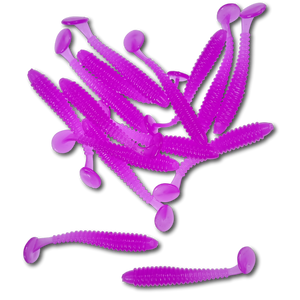
  • Paddle Tail Swimbait: Shad and baitfish — constant action with a consistent retrieve
  • Frog: Frogs, mice — topwater/vegetation coverage
  • Ned Bait: Small worm and craw hybrid — compact, bottom-oriented, works when nothing else does
  • Gilley: Gill-shaped baitfish — lifelike side-to-side action for bass and larger predators
  • Trailer: Craw and grub hybrids — adds action and bulk to jigs and chatterbaits
  • Goby: Round goby and similar bottom-dwelling baitfish — essential in Great Lakes regions
  • Hellgrammite: Dobsonfly larva — natural bass and trout forage in rivers and streams
  • Leech: Leeches — walleye, bass, and panfish forage in northern waters
  • Shrimp: Freshwater shrimp — trout, bass, and panfish in streams and clear lakes
  • Willowcat: Catfish-imitation profile — large predator forage, pike and trophy bass
  • Lizard: Salamander, mudpuppy — slow-falling, effective for spawning and post-spawn bass
  • Crappie Plastics: Small baitfish and insects — optimized in the 1.5–3" range for crappie and panfish
Color — Visibility Control for Every Water Condition +

Filter by Color to narrow options by water clarity and light level.

Color is the third lever, not the first. Don't obsess over it until fall rate and profile are dialed in. Once they are, color becomes a meaningful separator — especially in stained water or under high-pressure conditions.

  • Clear water: Natural colors — green pumpkin, watermelon, smoke, natural shad. Transparency matters. Avoid overly opaque or unnatural colors.
  • Stained or tannic water: Darker colors — black/blue, dark green pumpkin, junebug, purple. High contrast increases visibility.
  • Murky or muddy water: Chartreuse, white, pink, bright red. Maximum visibility. Go bold.
  • Overcast / low light: Darker solids (black, dark blue) create a strong silhouette against filtered light.
  • Bright sun, clear water: Drop back to natural translucent colors — bream, smoke with flake, or natural shad.
  • Crappie and panfish: Pink, white, chartreuse, and two-tone combos like white/chartreuse consistently outperform natural colors in this category.
  • Trout: Natural minnow colors (silver, olive, brown) plus brighter attractor colors like orange and pink depending on water clarity.
What Is a Soft Plastic Bait? +

Soft plastic baits are flexible, rubber-like lures made from plastisol or similar compounds. Unlike hard baits, they compress and flex when a fish bites — which translates to longer hold times and more hookups. They can be fished at every depth, on dozens of different rigs, and at any speed from dead-still to fast retrieve.

What makes them special is their versatility. A single paddle tail swimbait can be rigged on a jig head for open water, a weighted hook for weedless coverage, or a drop shot for finicky fish at depth. The plastic doesn't change — the rigging does. This category covers the full spectrum of profiles available in freshwater: from a tiny 1.5" crappie tube to an 8" willowcat meant to coax pike out of cover.

Soft plastics are the single most productive lure category in freshwater fishing by volume of fish caught. Learning this category well pays off for every species you target.

Where Soft Plastics Shine +

Soft plastics outperform hard baits in a handful of specific conditions:

  • Pressured fish: When fish have seen every crankbait and spinnerbait in the box, a natural-feeling soft plastic fools them more consistently.
  • Tight cover: Weedless rigging lets you fish through grass, wood, brush, and docks without constantly clearing the hook.
  • Slow fishing conditions: Cold fronts, post-spawn lethargy, high pressure — soft plastics fished slowly are almost always the correct call.
  • Precise depth targeting: You can suspend a drop shot plastic at exactly 14 feet and keep it there. You can't do that with most hard baits.
  • Multi-species applications: The same bag of 3" grubs that catches crappie will also catch bass, walleye, and trout. Hard to say that about any hard bait.
When & Where to Use Soft Plastics +

Boat without electronics: You're covering water by feel. Start with a Texas-rigged worm or craw on a 3/16–3/8 oz weight and fan-cast from the boat, working structure (points, transitions, laydowns). A paddle tail on a swimbait head covers open water quickly between spots. A fluke on a weighted hook is your versatile mover.

River fishing: Current changes everything. Light weights get washed around; go heavier than you think you need. Hellgrammites, leeches, and shrimp profiles excel in current because they mimic natural river forage. Ned rigs and tubes bounce along the bottom naturally in current. Lighter worm rigs work in eddies and slack water behind structure.

Bank fishing: You can't reposition. Work perpendicular to the bank, cover different depths on each cast, and let the bait's fall rate do the work. Texas-rigged worms and creatures are the bank angler's workhorses. Flukes and paddle tails cover shallow flats. A drop shot requires only a rod length of casting distance — excellent from shore.

Docks: Pitch and skip. Tubes, ned baits, and stick baits skip best under low-clearance docks. Use a 3/16 oz or lighter weight so the bait falls slowly once it's back in the shadows. Craws and creatures on a 1/4 oz jig head can be pitched to dock pilings vertically. Always start at the deepest end of the dock and work shallow.

Soft Plastics Are NOT… +

A few important clarifications to help you shop and fish more effectively:

  • Not a replacement for hard baits in covering water fast. If you need to locate fish quickly across a large flat or open water, a crankbait or spinnerbait covers more ground. Soft plastics are precision tools — they reward slower, more targeted presentations.
  • Not interchangeable with hard swimbaits. Paddle tail swimbaits in this category are soft-bodied and designed for light to medium tackle. Hard-bodied glide baits and large jointed swimbaits are a different category entirely.
  • Not one-size-fits-all by species. A 7" worm that catches bass will not catch crappie. Use size and profile deliberately — a bait that's too large for the target species simply won't get eaten.
  • Not weedless by default. Soft plastics require the right hook and rigging to be fished weedless. An exposed-hook jig head in thick grass will constantly foul. Pair the right hook setup to your cover.
Profile-by-Species Quick Reference +

Use this as a starting point when targeting a specific species and you're not sure which profile to reach for first:

  • Bass: Worms, craws, creatures, stick baits, flukes, paddle tails, tubes, ned baits, gilleys, lizards, trailers (on jigs), willowcat
  • Crappie: Crappie plastics (1.5–3"), small grubs (2–3"), small tubes (2–3"), small flukes (3")
  • Panfish: Small grubs (1–2"), crappie plastics (1.5–2"), tiny worms (2–3")
  • Walleye: Paddle tails (3–5"), grubs (3–4"), leeches (4–5"), shad profiles (3–5"), worms (4–6") on live-bait rigs
  • Trout: Shrimp (2–3"), small grubs (2–3"), small worms (3–4"), hellgrammites (3"), small paddle tails (3")
  • Pike: Large paddle tails (5–8"), willowcat, large flukes (5–7"), large worms (7"+)
Rigging Overview — Which Rig for Which Profile +

The full rigging breakdown lives in the Techniques and Execution tabs, but here's the top-level match between profile and rig to help you start correctly:

  • Worm: Texas rig, Carolina rig, drop shot, Neko, wacky
  • Craw / Creature: Texas rig, punching rig, jig trailer, football jig
  • Stick bait: Wacky rig, Neko rig, weightless Texas, drop shot
  • Grub: Jig head, shaky head, drop shot, split shot rig
  • Tube: Internal jig head, Texas rig, drop shot, football head
  • Fluke / Shad / Minnow: Weightless hook, weighted hook, jig head, drop shot
  • Paddle Tail Swimbait: Swimbait head, Texas rig, Alabama rig, under-spin
  • Ned Bait: Ned head (mushroom jig), small drop shot
  • Frog: Wide-gap weedless hook, frog hook
  • Leech: Shaky head, drop shot, slip sinker rig, walleye harness
  • Goby: Drop shot, tube head, shaky head
  • Hellgrammite: Drop shot, split shot rig, jig head
  • Shrimp: Drop shot, split shot, light jig head
  • Trailer: Jig hook, chatterbait hook — used to add action behind a jig or bladed bait

For the full rig-by-rig breakdown with weights, line, and rod pairing, see the Best Bass Fishing Rigs page.