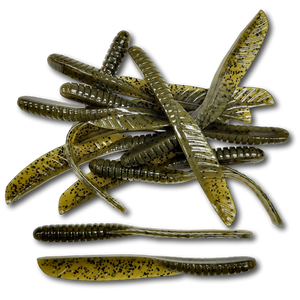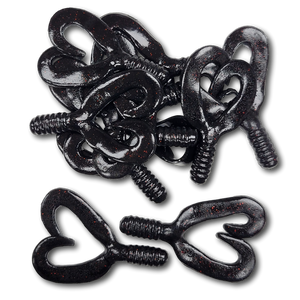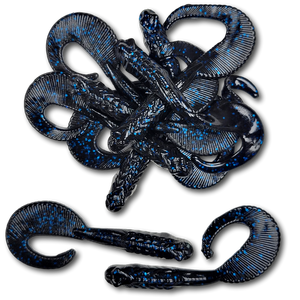

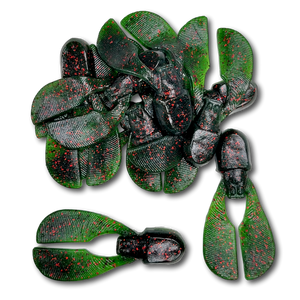

So Good Baits Hand Poured 2.75" Forked Tail Minnow Soft Plastic Bait
$7.99
(No reviews yet)

Write a Review
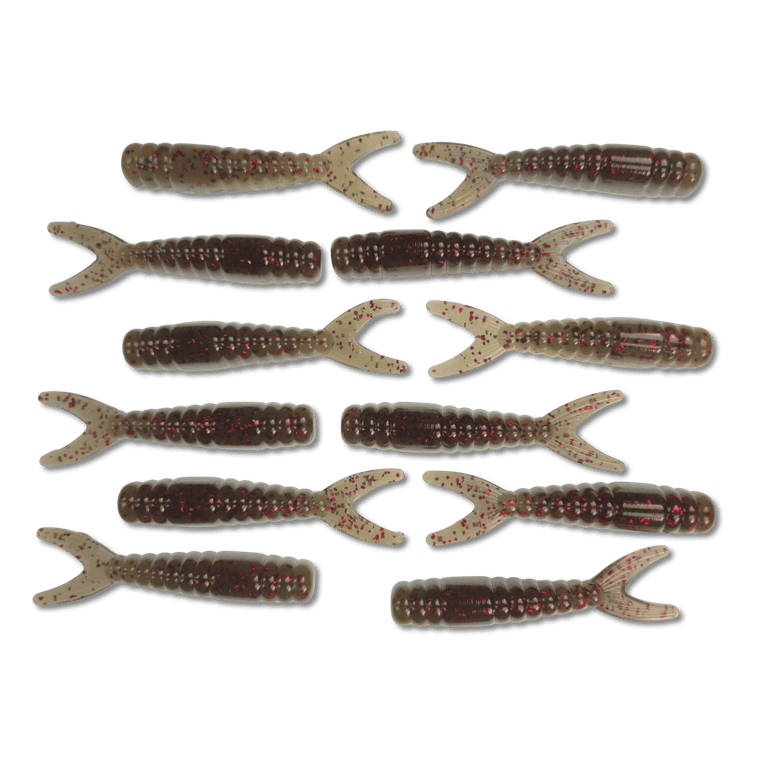
So Good Baits Hand Poured 2.75" Forked Tail Minnow Soft Plastic Bait
Underspin
When & Where: Open water transitions, points, humps, and suspended walleye over deeper structure—anywhere you want a minnow riding just above bottom or mid-column with flash.
How: Cast or vertical drop and swim it back with a steady retrieve, varying speed until you find what triggers fish. Let it pendulum on the pause—the forked tail keeps moving even when you stop.
Why: The ribbed body and forked tail create a tight, natural kick that pairs perfectly with the spinning blade below, giving walleye two triggers at once: flash and lifelike action.
Tuning: Go lighter for shallower drifts; heavier underspins get you down faster in current or deeper water. Match head weight to your depth and desired sink rate.
Drop Shot
When & Where: Deep clear-water walleye, suspended fish, and pressured fish that want a slow-moving target presented at an exact depth.
How: Nose-hook it or hook through the back and let it hang horizontally. Small shakes and long pauses—the forked tail quivers on the slightest rod movement.
Why: The compact 2.75" profile reads "easy meal" at any depth, and the ribbed body transmits subtle rod vibration into realistic tail kick.
Tuning: Longer leader = more natural drift and swing; shorter leader = more direct control and precise depth targeting.
Ned Rig
When & Where: Rocky points, gravel flats, and slow finesse presentations when walleye and bass are sluggish or hugging bottom.
How: Rig it straight on a light Ned head so it stands up at an angle. Drag slowly, pause often—the forked tail fans out on the bottom and flutters back on every pause.
Why: A standing minnow profile at rest is a hard target for bottom-oriented fish to pass up, and the soft forked tail adds subtle life without any rod movement needed.
Tuning: Lighter heads keep the bait almost horizontal; slightly heavier heads give a more dramatic stand-up angle in current.
Standard (Ball) Jig Head
When & Where: Rivers, current seams, gravel bars, and walleye structure where a simple swim or drag presentation covers water efficiently.
How: Cast up and across current and swim it back with a slow, steady lift-and-drop cadence, or drag it along bottom with short twitches.
Why: The elongated ribbed body tracks straight and the forked tail gives a natural kick at nearly any retrieve speed—effective from slow crawl to moderate swim.
Tuning: Match head weight to current speed and depth. Heavier gets down faster in moving water; lighter glides more naturally in slack water.
Wacky Rig
When & Where: Calm conditions, clear water, slow presentations over shallow flats and around docks where a falling, fluttering profile triggers reluctant bites.
How: Hook through the middle of the body and let it sink on a slack line. Both the nose and forked tail kick outward on the fall—retrieve with slow lifts and let it sink back down.
Why: The wacky hook point frees both ends of the bait to move independently, turning the forked tail and ribbed body into a full-action falling presentation.