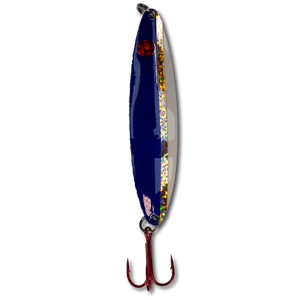


Litts Fish Lures Custom 63 Split Window Pattern Hand Painted Flutter / Trolling Spoons
$14.99
(No reviews yet)

Write a Review

Litts Fish Lures Custom 63 Split Window Pattern Hand Painted Flutter / Trolling Spoons
Open-Water Trolling
When & Where: The core presentation for this spoon. Works across open basin water, along thermal breaks, and over structure for salmon, trout, and walleye. At home anywhere you're running a spread — Great Lakes, big inland water, or any fishery where flutter action triggers pelagic fish.
How: Run it on a standard trolling spread behind a downrigger, dipsy diver, or planer board. Speed between 2.0–3.5 mph is the typical productive range; the flutter action engages well across that window. Vary speed slightly when fish are marking but not committing.
Why: The spoon body flutter gives an erratic, wounded-baitfish action at trolling speeds. The '63 Split Window pattern's bold swirling paint over a polished metal back creates flash and depth that shifts as the spoon moves — the backing shows through the paint to produce effects that change with angle and light.
Tuning: Adjust trolling depth with ball weight or downrigger position. The #5 (4.5") body pushes more water and runs with a wider flutter; the #4 (3.75") is a tighter, quicker action — useful when fish are keyed on smaller baitfish or when you want a different cadence in the spread.
Downrigger Presentation
When & Where: Targeting fish holding at a specific depth — common on Lake Superior and other Great Lakes where salmon and lake trout suspend along temperature breaks or hug bottom structure at depth.
How: Clip the line to a downrigger ball and set the release tension light enough to trip cleanly on the strike. Run a 6–10 foot leader from the ball to the spoon to give it room to work freely.
Why: Puts the spoon precisely in the strike zone. The '63 Split Window's translucent paint-over-metal construction means the backing color keeps contributing at depth — the warm glow of brass or the cold flash of nickel bleeds through the paint even as ambient light decreases.
Tuning: Gregory's tip: at deeper presentations, polished brass on the back tends to maintain visibility better in low-light, deep-water conditions than nickel. Both work — brass is a practical starting point when you're running 40 feet or more.
Planer Board Spread
When & Where: Covering water laterally — useful in shallower trolling passes, near-shore salmon runs, or when fish are spread across a flat rather than holding at a defined depth. Standard on Great Lakes charter programs.
How: Attach to an inline board or a side-planer to push the spoon out to the side of the boat's wake. The flutter action remains effective well out to the sides. Stagger depths and distances across a full spread.
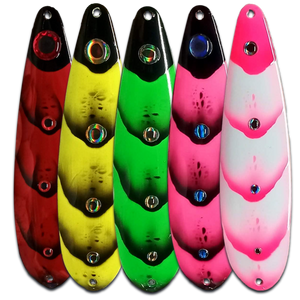
Why: Gets the spoon away from boat pressure and into undisturbed water. The '63 Split Window's varied color palette makes it easy to run multiple colors in a spread without doubling up — each colorway reads differently from the others.
Tuning: Mix the #4 and #5 in the same spread for size contrast. Run different back finishes (nickel and brass) across rods to cover more variables on the same pass.
Casting (Larger Waters / Shore)
When & Where: The #5 has enough body weight to cast a fishable distance, making it an option from piers, breakwalls, or rocky Lake Superior shoreline for trout and coho working the shallows, especially during spring and fall runs.
How: Cast across current or along structure edges and retrieve at a moderate pace that keeps the spoon fluttering. A slow, irregular retrieve — with brief pauses — mimics a struggling baitfish and can draw reaction strikes.
Why: The '63 Split Window's bold color over flashing metal back gives it strong visual presence from shore, where you need a spoon that reads well through varying depths of water on the retrieve.
On-the-water overview (demo copy)
This is placeholder text for Jiggin’ Johnson’s new template shell.
Once we’re happy with the layout and behavior, we’ll plug in real product
descriptions, rigging tips, and JJ-specific language.
Specs & build (demo copy)
Specs & build (demo copy)
Care & storage (demo copy)
Care & storage (demo copy)
Best ways to fish it (demo)
Swim Jig Trailer
Shallow grass, slow roll
Texas Rig
Pitching to cover
Ball Jig Head
Dragging sand or rock
Split Shot
Natural subtle glides
Related Products
-
-
Sale
Parsons Lures Flutter Spoons
$3.50 - $4.50 -
Sale
Parsons Lures 5/16 ounce Flutter Spoons
$9.99 $6.50 -
Sale
Parsons Lures "Bloodsplatter" Pattern Spoon
$3.50 - $7.50